AI Suggested SEO Improvements for This Blog
I asked an AI assistant to audit this blog for SEO issues and implement fixes. This post documents every change that was made, why it matters, and where to learn more.
The blog is built with Hugo using a custom fork of the hugo-coder theme, deployed on Netlify.
What Was Audited
The audit covered four areas:
- Hugo configuration (
config-hugo-coder-custom.toml) - Theme layout templates (
layouts/) - Content frontmatter (per-post metadata)
- The default archetype for new posts
Changes Made
1. Enable robots.txt Generation
File: config-hugo-coder-custom.toml
enableRobotsTXT = true
Hugo does not generate a robots.txt by default. Without it, search engine crawlers get no guidance on which pages to index or avoid. Enabling this setting causes Hugo to auto-generate a robots.txt at the site root based on your content structure.
Why it matters: robots.txt is one of the first files a crawler fetches. Without it, Googlebot proceeds with no restrictions, which is generally fine, but having it explicitly present signals a well-maintained site. You can also extend it later to block crawling of specific paths (e.g. draft preview URLs).
Reference: Google — robots.txt introduction
2. Enable enableGitInfo
File: config-hugo-coder-custom.toml
enableGitInfo = true
Hugo can read git commit metadata to automatically set the lastmod date for every page — without you manually adding lastmod: to each post’s frontmatter. This is especially useful for a blog with 100+ posts.
Why it matters: Google uses lastmod in sitemaps as a signal for recrawl prioritisation. Pages with a recent lastmod are more likely to be recrawled sooner when content changes. Without enableGitInfo, the lastmod falls back to the build time, which is misleading.
Reference: Hugo Docs — Git Info Variables
3. Explicit Sitemap Configuration
File: config-hugo-coder-custom.toml
[sitemap]
  changefreq = "monthly"
  priority = 0.5
  filename = "sitemap.xml"
Hugo generates a sitemap automatically, but without explicit configuration the changefreq and priority fields are omitted. Adding them gives crawlers a hint about how often content changes and its relative importance.
Why it matters: While Google has stated that it largely ignores priority and changefreq, Bing and other crawlers still respect them. More importantly, making the sitemap configuration explicit makes it easier to override per-section if needed in the future.
Reference: Hugo Docs — Sitemap Templates
4. Remove Unused Language (pt-br)
File: config-hugo-coder-custom.toml
The hugo-coder theme ships with a Portuguese (pt-br) language example in its sample config. This blog has no Portuguese content, but the language block was present, which caused Hugo to generate <link rel="alternate" hreflang="pt-br"> tags on every page.
Why it matters: hreflang alternate links pointing to non-existent URLs are a known crawl issue. Google’s Search Console flags these as errors, and they waste crawl budget by signalling URLs that return 404. Removing the unused language block eliminates this entirely.
Reference: Google — hreflang and alternate pages
5. Improved Global Site Description and Keywords
File: config-hugo-coder-custom.toml
Before:
description = "amt8u's blog"
keywords = "blog,developer,personal"
After:
description = "cybercafe.dev — a personal blog by amt8u covering web development, JavaScript, DevOps, gaming, gadget reviews, and tech experiments."
keywords = "blog,web development,javascript,devops,gaming,tech reviews,hugo,nodejs"
These values are used as fallbacks when individual posts do not have their own description or keywords in frontmatter. The old values were too generic to be useful in search results.
Why it matters: The description meta tag is what Google typically shows as the snippet under your page title in search results. A vague description like “amt8u’s blog” does not give a user any reason to click. Specific, keyword-relevant descriptions improve click-through rate (CTR).
6. Improved Homepage <title> Tag
File: themes/hugo-coder-custom/layouts/_default/baseof.html
Before:
<title>{{ block "title" . }}{{ .Site.Title }}{{ end }}</title>
After:
<title>{{ block "title" . }}{{ if .IsHome }}{{ .Site.Title }} — Web Dev, Gaming & Tech by amt8u{{ else }}{{ .Site.Title }}{{ end }}{{ end }}</title>
The homepage was rendering as just cybercafe.dev in browser tabs and search results. Individual post pages correctly render as Post Title · cybercafe.dev via their own template override. The fix only affects the homepage — post titles are unchanged.
Why it matters: The <title> tag is the most heavily weighted on-page SEO element. For the homepage specifically, it is what appears as the blue link in Google results. A descriptive title helps both relevance ranking and user click-through.
Reference: Google — Title link best practices
7. JSON-LD Structured Data (Schema.org)
File: themes/hugo-coder-custom/layouts/partials/head/jsonld.html (new file)
The theme already included Hugo’s built-in OpenGraph and Twitter Card templates, but had no JSON-LD structured data. A new partial was created and wired into extensions.html:
- Homepage gets a
WebSiteschema withname,url,description, andauthor - Every post gets a
BlogPostingschema withheadline,description,url,datePublished,dateModified,author,publisher, andimage
{
  "@context": "https://schema.org",
  "@type": "BlogPosting",
  "headline": "Post Title",
  "datePublished": "2026-05-28T10:57:00+05:30",
  "dateModified": "2026-05-28T10:57:00+05:30",
  "author": { "@type": "Person", "name": "amt8u" },
  "publisher": { "@type": "Organization", "name": "cybercafe.dev" }
}
Why it matters: JSON-LD is Google’s preferred format for structured data. It enables rich results in Google Search — things like article dates, author names, and breadcrumbs displayed directly in the SERP, which increases visibility and CTR without any ranking signal change. OpenGraph handles social sharing previews (Facebook, LinkedIn, Slack etc.) but does not contribute to Google rich results.
References:
8. Per-Post SEO Frontmatter (Casio Review Post)
For the article the-real-review-of-casio-g-shock-gbx-100, several specific issues were fixed:
a. Improved description
Before: An honest review of the Casio G-Shock GBX-100..
After: A real-world review of the Casio G-Shock GBX-100 — MIP display, step counter, 1-year battery life, notifications, and whether it is worth buying in India at Rs 12000.
A good meta description is 120–155 characters, includes the primary keyword naturally, and reads like a human wrote it for a human — not stuffed with keywords.
b. Added keywords to frontmatter
keywords : ['casio g-shock gbx-100 review', 'gbx-100 india', 'g-shock step counter', 'mip display watch', 'casio watch battery life']
While Google no longer uses the keywords meta tag for ranking, Bing still does, and having them defined per post is good practice for content clarity and consistency.
c. Fixed thumbnail/images extension mismatch
# Before
thumbnail : "images/casio-g-shock-gbx-100.jpg"
images : ["images/casio-g-shock-gbx-100.jpeg"]  # wrong extension

# After
images : ["images/casio-g-shock-gbx-100.jpg"]
The images field is used by Hugo’s built-in OpenGraph template to set the og:image meta tag — what appears as the preview image when the post is shared on social platforms. A wrong extension produces a broken image URL in the OG tag, meaning no preview image on LinkedIn, Twitter, or Slack.
d. Added alt text to all images
All images with empty alt text (![]()) were updated with descriptive text. Example:

Why it matters: Alt text serves two purposes — accessibility for screen readers, and Google Images indexing. Google uses alt text to understand what an image depicts. Descriptive, keyword-relevant alt text can drive traffic from Google Images and improves overall page relevance signals.
Reference: Google — Image SEO best practices
9. Updated Default Archetype
File: archetypes/default.md
Before: Only had title, date, and draft.
After:
---
title : '{{ replace .File.ContentBaseName "-" " " | title }}'
url : '{{ .File.ContentBaseName }}'
description : ''
date: '{{ .Date }}'
draft : true
tags : []
keywords : []
thumbnail : ""
images : []
---
Every new post created with hugo new posts/my-post now includes all SEO-relevant frontmatter fields pre-populated, so they cannot be accidentally omitted.
10. Thumbnail Image for This Post
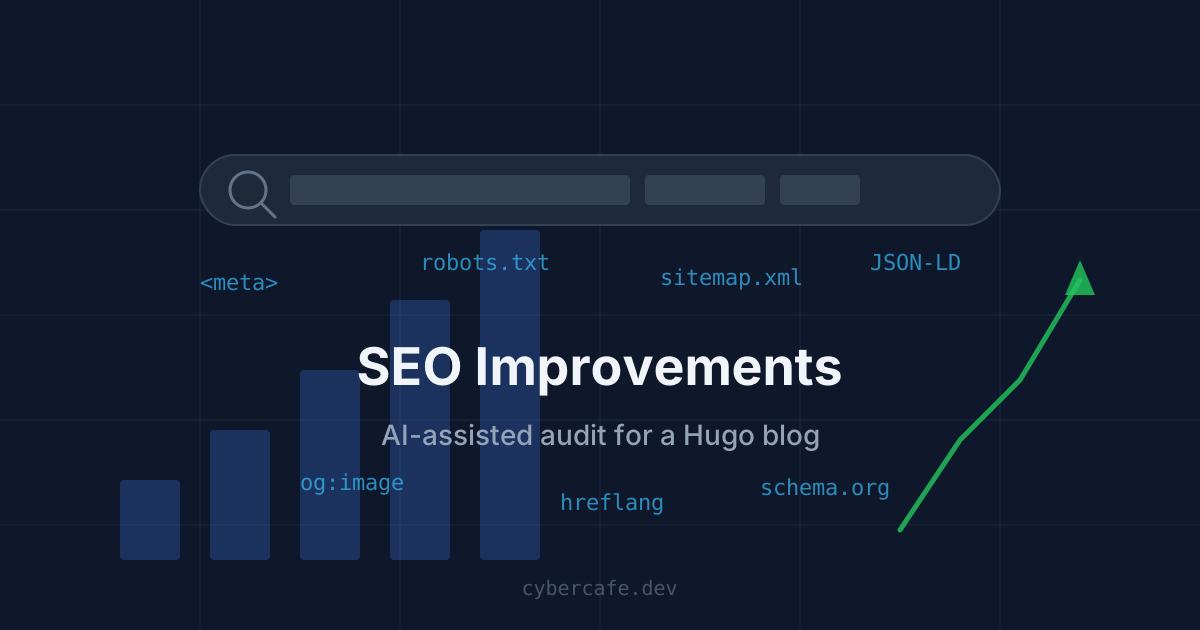
As a practical demonstration of the image-related improvements above, a thumbnail was created for this very article and set in the frontmatter via thumbnail and images fields.

The image was generated as an SVG and visually represents the key concepts covered in this post — a search bar, rising bar chart, an upward trend line, and floating SEO-related terms (<meta>, robots.txt, sitemap.xml, JSON-LD, og:image, schema.org). Using SVG keeps it resolution-independent and adds no external dependencies.
The images frontmatter field ensures it is picked up by Hugo’s built-in OpenGraph template as the og:image, so when this post is shared on social platforms it renders with a meaningful preview instead of a blank card.
What Still Needs Attention
- ~86 posts are missing a
description— they fall back to the auto-generated.Summary(first 70 words). These need to be written manually, one post at a time. There is no automated shortcut that produces quality descriptions. - Image alt text on older posts — only the new Casio post was fixed. Other posts with images should be reviewed similarly.
- No analytics configured — the config has placeholders for Google Analytics, Plausible, GoatCounter etc., all commented out. Without analytics you cannot measure the impact of these SEO changes.
End